




Understanding Kidney Function Testing
The role of creatinine, urea and uric acid in assessing kidney health.
What Do the Kidneys Do?
The kidneys are two bean-shaped organs located on either side of the spine, just below the rib cage. Their best-known function is to filter the blood, removing waste products and excess water to form urine. They also help regulate the body's fluid and electrolyte balance, maintain acid-base balance, support blood pressure regulation, and contribute to the production of red blood cells and the maintenance of healthy bones.
Because the kidneys perform several essential functions, changes in kidney health can affect more than urine production. Some kidney conditions develop gradually and may not cause obvious symptoms in the early stages. Laboratory testing therefore plays an important role in identifying and monitoring possible kidney problems.
Why Is Kidney Function Testing Important?
Kidney function tests help healthcare professionals assess how well the kidneys are working and identify changes that may need further investigation. Testing can be particularly important for people with risk factors such as diabetes, high blood pressure, cardiovascular disease, or a family history of kidney disease.
No single blood marker provides a complete picture of kidney health. Clinical assessment commonly combines blood tests with urine tests and other information. Estimated glomerular filtration rate (eGFR), usually calculated using blood creatinine together with factors such as age and sex, is a key measure of filtration. Urine albumin testing can help detect kidney damage.
Three Biomarkers Related to Kidney Health
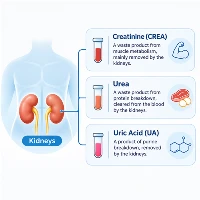
Creatinine, urea and uric acid are three biomarkers that can provide different types of information relevant to kidney health. Their clinical significance is not identical, and each should be interpreted in the appropriate context.
Creatinine
Creatinine is a waste product formed through normal muscle metabolism. It enters the bloodstream and is removed mainly by the kidneys. When kidney filtration decreases, blood creatinine may rise. Creatinine is widely used to estimate glomerular filtration rate (eGFR), although interpretation can also be influenced by factors such as muscle mass, age, diet, and certain medicines.
Urea
Urea is produced in the liver when the body processes protein. It circulates in the blood and is normally removed by the kidneys through urine. Blood urea levels may increase when kidney function is reduced, but they can also be affected by hydration, protein intake, liver function, and other conditions. For this reason, urea is interpreted alongside other clinical findings rather than on its own.
Uric Acid
Uric acid is formed when the body breaks down purines, substances found naturally in the body and in some foods. The kidneys help remove uric acid from the blood. Higher levels may occur when the body produces too much uric acid or does not remove enough of it. Elevated uric acid is associated with conditions such as gout and may be seen in people with kidney disorders, but it is not, by itself, a direct measure of the kidney's filtration rate.
How Are These Results Interpreted?
Creatinine and urea provide information about waste products that are normally cleared from the blood by the kidneys. Uric acid provides additional information about purine metabolism and urate handling. Looking at these markers together may help provide a broader clinical picture, but their results must be interpreted in context.
Healthcare professionals may also consider eGFR, urine albumin, medical history, medication use, hydration status, and repeat test results. A single abnormal result does not necessarily confirm kidney disease, and a normal result does not rule out every kidney condition.
Kidney Function Testing with LYSUN
LYSUN offers a renal function analyzer with testing options for three biomarkers related to kidney health: creatinine, uric acid, and urea. These tests provide relevant measurements that can support the assessment of renal function as part of a broader clinical evaluation.
The selection of tests and interpretation of results should be based on the patient's clinical needs and the instructions for the specific test system.